
The Critical Role of Visibility in Preserving Perishable Goods
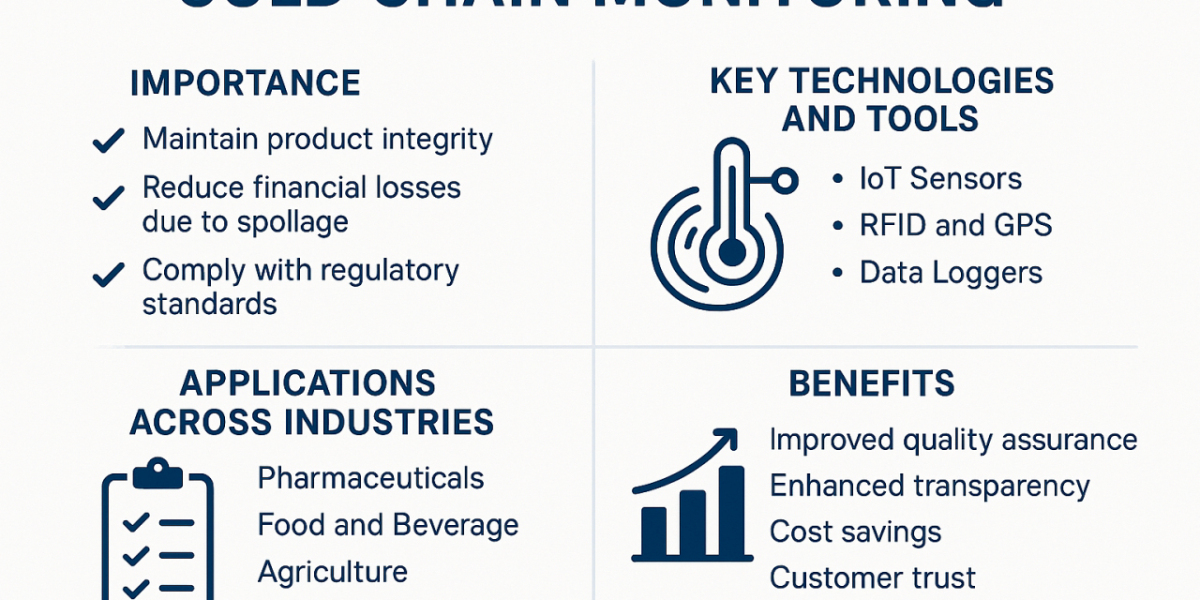
In an increasingly interconnected global economy, the journey of temperature-sensitive products—from life-saving vaccines to fresh produce—demands unwavering precision. The Cold Chain Monitoring Market is the technological backbone that ensures this precision, providing the visibility and control necessary to maintain product integrity from origin to destination. This market encompasses a sophisticated array of sensors, data loggers, real-time tracking devices, and cloud-based software platforms designed to monitor and manage temperature-sensitive supply chains. As global trade expands, consumer demand for fresh, high-quality goods intensifies, and the pharmaceutical industry faces unprecedented logistical challenges, the role of cold chain monitoring has transitioned from a value-added service to an absolute necessity, safeguarding billions of dollars in product value and, more critically, protecting public health.
Key Growth Drivers: The Forces Behind Market Expansion
Several powerful forces are propelling the growth of the cold chain monitoring market. The most significant driver is the exponential growth of the biopharmaceutical sector, particularly the distribution of mRNA vaccines and complex biologic drugs that require ultra-low temperature storage and meticulous monitoring throughout their journey. The global push for food safety and the reduction of food waste, with the United Nations estimating that one-third of all food produced is lost or wasted, has created immense pressure on the food and beverage industry to adopt advanced monitoring solutions. Furthermore, stringent regulatory frameworks, such as the FDA's Drug Supply Chain Security Act (DSCSA) and the EU's Good Distribution Practices (GDP) guidelines, mandate rigorous temperature control documentation, forcing companies to invest in sophisticated monitoring technologies to ensure compliance and avoid costly penalties and product recalls.
Consumer Behavior and E-commerce Influence: The Demand for Freshness Delivered
The explosive growth of e-commerce, particularly in the grocery and meal-kit sectors, has fundamentally altered consumer expectations around food delivery. Consumers now demand that fresh, frozen, and perishable goods arrive at their doorstep in perfect condition, creating a massive logistical challenge that drives the need for robust cold chain monitoring. The "last mile"—the final leg of delivery to the consumer—has become the most critical and challenging segment of the cold chain, requiring innovative monitoring solutions that can track temperature fluctuations in real-time, even in unrefrigerated delivery vehicles. This shift toward direct-to-consumer models has also increased the demand for reusable, IoT-enabled monitoring devices that provide end-to-end visibility and enhance consumer trust by offering proof of proper handling throughout the delivery process.
Regional Insights and Preferences: A Global Patchwork of Priorities
The cold chain monitoring market exhibits distinct regional characteristics shaped by economic development, climate conditions, and regulatory maturity. North America and Europe represent the most mature markets, characterized by high adoption rates of advanced IoT and cloud-based monitoring solutions, driven by stringent regulatory compliance requirements and a strong focus on pharmaceutical logistics. The Asia-Pacific region is witnessing the fastest growth, fueled by rapidly expanding pharmaceutical manufacturing hubs in countries like China and India, a growing middle class demanding higher-quality food products, and significant investments in cold chain infrastructure to reduce post-harvest losses. In contrast, Latin America and the Middle East & Africa present unique challenges and opportunities, with high ambient temperatures placing extreme demands on cold chain infrastructure and creating a pressing need for robust, reliable monitoring solutions to prevent spoilage and ensure the efficacy of temperature-sensitive medical supplies.
Technological Innovations and Emerging Trends: The Digital Cold Chain
The cold chain monitoring landscape is being transformed by a wave of technological innovations. The Internet of Things (IoT) has enabled the deployment of smart, connected sensors that provide real-time visibility into temperature, humidity, shock, and location data throughout the supply chain. The integration of blockchain technology is emerging as a powerful trend, offering immutable, tamper-proof records of temperature data that enhance traceability, streamline regulatory audits, and build trust among stakeholders. Artificial intelligence (AI) and machine learning (ML) algorithms are being deployed to analyze vast datasets, enabling predictive analytics that can anticipate potential temperature excursions, optimize routing, and proactively prevent spoilage events before they occur. Additionally, the development of low-power, wide-area networks (LPWAN) such as LoRaWAN and NB-IoT is enabling cost-effective, long-range connectivity for monitoring shipments across vast geographical areas without the need for expensive cellular infrastructure.
Sustainability and Eco-Friendly Practices: Greening the Cold Chain
As environmental concerns take center stage globally, sustainability has become a critical focus within the cold chain monitoring market. Traditional single-use data loggers, while effective, contribute significantly to electronic waste. In response, the industry is witnessing a strong shift toward reusable, IoT-enabled monitoring devices that can be deployed hundreds of times, dramatically reducing waste and lowering the total cost of ownership. Companies are also leveraging advanced monitoring data to optimize refrigeration systems, reducing energy consumption and carbon emissions. Furthermore, the push for sustainable refrigerants and the adoption of electric and alternative-fuel refrigerated vehicles are being supported by monitoring systems that track energy efficiency and system performance. This convergence of monitoring technology with sustainability initiatives not only reduces environmental impact but also aligns with the corporate social responsibility goals of major pharmaceutical and food companies.
Challenges, Competition, and Risks: Navigating a Complex Landscape
Despite its robust growth, the cold chain monitoring market faces significant challenges. The high initial investment required for deploying IoT sensors, cloud platforms, and integrating with existing enterprise systems can be a barrier for small and mid-sized players. Data fragmentation and interoperability issues remain persistent problems, as different stakeholders—manufacturers, logistics providers, and retailers—often use disparate systems that do not communicate seamlessly, creating gaps in end-to-end visibility. The proliferation of low-cost, low-quality monitoring devices has created intense price competition, particularly in the food segment, potentially compromising reliability. Additionally, cybersecurity risks are emerging as a critical concern, as connected monitoring systems become potential entry points for malicious actors seeking to disrupt supply chains or compromise sensitive product data.
Future Outlook and Investment Opportunities: A Vision of End-to-End Visibility
The future of the cold chain monitoring market is bright, characterized by the pursuit of true end-to-end visibility and predictive intelligence. The next frontier is the creation of fully integrated digital supply networks where every shipment, from the point of origin to the final consumer, is continuously monitored and managed through a single, unified platform. Investment opportunities abound in companies developing advanced sensor technologies, AI-powered analytics platforms, and blockchain-based traceability solutions. The convergence of cold chain monitoring with other technologies, such as autonomous refrigerated vehicles and drone delivery, represents a frontier for innovation. Additionally, the growing focus on personalized medicine and cell and gene therapies, which often require ultra-low temperature storage down to -80°C or even cryogenic conditions, will drive demand for specialized, high-precision monitoring solutions capable of meeting the most stringent requirements.
Conclusion
The cold chain monitoring market stands as a critical enabler of modern global commerce, ensuring that the temperature-sensitive products upon which we depend—from the food on our tables to the medicines that heal us—arrive safely and efficaciously. Driven by the expansion of biopharmaceuticals, the growth of e-commerce grocery, and increasingly stringent regulations, the market is experiencing robust growth. Technological innovations in IoT, AI, and blockchain are transforming monitoring from a reactive documentation exercise into a proactive, predictive intelligence tool. While challenges related to cost, interoperability, and cybersecurity persist, the long-term outlook remains exceptionally positive. For stakeholders across the cold chain ecosystem, investing in advanced monitoring capabilities is no longer a matter of competitive advantage but a fundamental requirement for ensuring product integrity, regulatory compliance, and consumer trust in an increasingly complex and demanding world.
Access Customized Regional And Country Reports:
Brazil Cold Chain Monitoring Market
Canada Cold Chain Monitoring Market
China Cold Chain Monitoring Market
Europe Cold Chain Monitoring Market
France Cold Chain Monitoring Market
Gcc Cold Chain Monitoring Market
Germany Cold Chain Monitoring Market
India Cold Chain Monitoring Market
Italy Cold Chain Monitoring Market
Japan Cold Chain Monitoring Market
South America Cold Chain Monitoring Market
South Korea Cold Chain Monitoring Market
Spain Cold Chain Monitoring Market