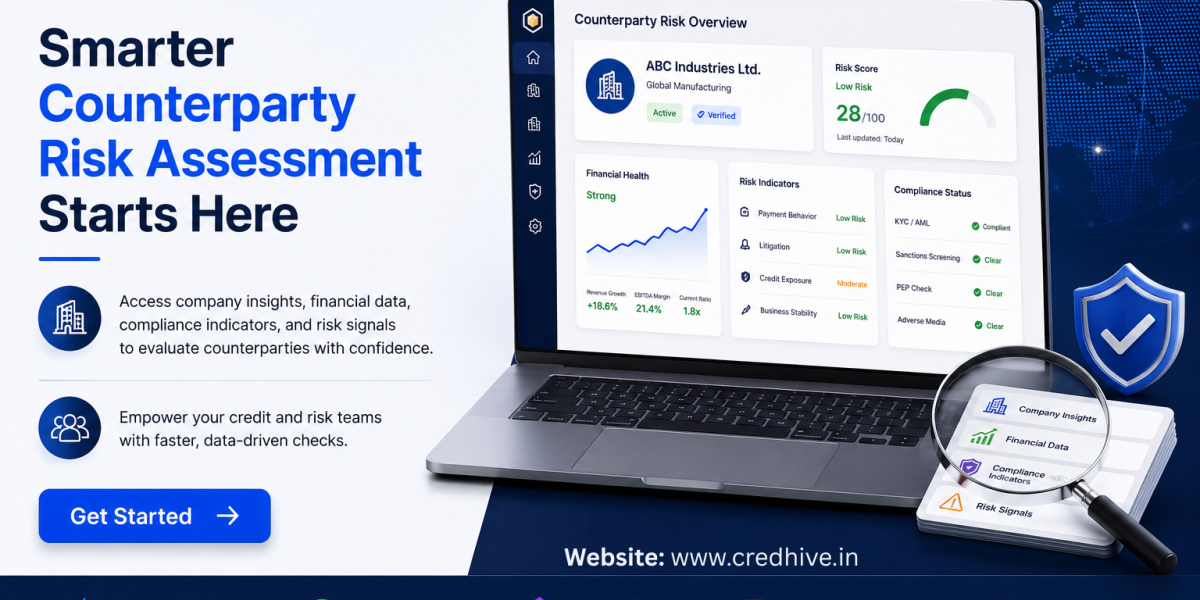

Financial institutions and enterprises make decisions about customers, borrowers, suppliers, partners, and investments every day. The quality of these decisions depends heavily on how well an organization understands potential risks. Traditional risk assessment often relies on historical information and periodic reviews, but today's business environment changes rapidly.
Risk Intelligence provides a more dynamic approach by bringing together relevant data, risk indicators, and analytical insights to help organizations identify potential threats and make informed decisions. For banks, NBFCs, fintech companies, lenders, insurers, and enterprises, it can support everything from credit assessment and vendor due diligence to portfolio monitoring and compliance.
What Is Risk Intelligence?
Risk Intelligence is the process of collecting, analyzing, and interpreting information to identify, assess, and monitor risks that could affect a business or financial decision.
Unlike a simple risk report, risk intelligence focuses on turning multiple data points into actionable insights. These may include company information, financial indicators, credit behavior, ownership changes, regulatory information, legal developments, industry trends, and other relevant signals.
For example, a lender assessing an SME may look beyond its current financial statements. Changes in company ownership, declining business performance, increasing liabilities, or adverse industry developments could provide additional context for the credit decision.
The objective is to give decision-makers a more complete and timely view of risk.
Why Risk Intelligence Matters
Risk rarely remains static. A company that appears financially healthy today may face challenges six months later due to market conditions, management changes, regulatory developments, or declining cash flows.
This makes continuous risk visibility particularly important.
Effective Risk Intelligence can help organizations:
- Identify emerging risks earlier
- Improve credit and financial decisions
- Strengthen third-party risk management
- Reduce potential losses
- Improve compliance monitoring
- Prioritize high-risk cases
- Support faster decision-making
- Improve operational efficiency
Rather than treating risk assessment as a one-time exercise, organizations can use intelligence to monitor how risk changes over time.
Key Sources of Risk Intelligence
The quality of risk intelligence depends on the relevance and reliability of the underlying data.
Company and Corporate Data
Corporate registration details, ownership information, directors, business status, and organizational structure can help establish the identity and profile of a business.
For lenders and enterprises, this information can also highlight changes that may warrant further investigation.
Financial Information
Financial statements, revenue trends, profitability, leverage, liquidity, and other financial indicators can provide insight into a company's financial health.
A deterioration in these indicators may become an early warning signal for lenders or suppliers.
Credit and Payment Behavior
Credit history and repayment patterns can provide valuable information when evaluating borrowers or counterparties.
For example, repeated payment delays may indicate increasing financial pressure even when an account has not yet reached a serious delinquency stage.
Regulatory and Legal Information
Regulatory actions, litigation, compliance issues, and other relevant legal developments can materially affect a company's risk profile.
Monitoring these signals can help organizations identify issues that may not appear in traditional financial data.
Industry and Market Signals
A company's risk is also influenced by its operating environment. Changes in commodity prices, regulations, consumer demand, supply chains, or industry conditions can affect business performance.
Combining company-level and industry-level information provides a broader perspective.
Risk Intelligence in Credit Risk Management
Credit decisions are one of the most important applications of Risk Intelligence.
Banks, NBFCs, and fintech lenders can use relevant risk information during customer onboarding, underwriting, and ongoing portfolio monitoring.
For example, an NBFC evaluating a business loan application may identify a borrower with acceptable financial ratios but discover that the company's industry is experiencing significant stress. This does not automatically mean the application should be rejected. Instead, the information can prompt additional analysis and potentially influence the structure, limits, or monitoring requirements of the facility.
This creates a more informed approach to credit risk assessment.
Risk Intelligence for Portfolio Monitoring
Risk intelligence becomes even more valuable after a loan has been approved.
A borrower's financial condition can change during the loan lifecycle. Organizations can monitor selected indicators for changes in business status, financial performance, repayment behavior, ownership, legal developments, or other relevant factors.
When multiple indicators change at the same time, the account can be flagged for review.
This allows lenders to move from reactive risk management toward early warning risk detection.
Risk Intelligence for Vendor and Third-Party Risk
Enterprises increasingly depend on external suppliers and service providers. A problem with a critical vendor can disrupt operations, expose sensitive information, or create financial and reputational consequences.
Risk intelligence can support both initial vendor due diligence and ongoing monitoring.
For example, an organization may monitor a critical technology provider for changes in ownership, financial condition, regulatory status, legal issues, or other relevant events.
This helps procurement and risk teams prioritize vendors that require closer attention.
Role of Technology in Risk Intelligence
Modern risk intelligence platforms can consolidate data from multiple sources and present relevant information through dashboards, alerts, reports, and analytical workflows.
Automation can help organizations identify predefined risk indicators without requiring teams to manually search multiple databases.
For instance, if a company in a lender's portfolio experiences a significant change in business status, an automated monitoring system can generate an alert and route it to the appropriate risk or relationship team.
Technology therefore improves both risk visibility and operational efficiency.
Practical Example: Risk Intelligence for an NBFC
Consider an NBFC with thousands of SME borrowers.
A conventional monitoring process may focus primarily on repayment status. However, a risk intelligence approach can combine repayment information with business and external signals.
Suppose one borrower begins making payments later than usual while its financial performance declines and its industry faces weaker demand. Individually, these indicators may not justify immediate action. Together, they may indicate a developing risk pattern.
The NBFC can prioritize the account for review, request updated information, and determine whether additional monitoring is appropriate.
The value lies in identifying the change early—when there is still an opportunity to respond.
Best Practices for Implementing Risk Intelligence
Organizations should begin by identifying the risks that matter most to their business objectives. Not every available data point is useful.
Important practices include:
- Use reliable and relevant data sources
- Define clear risk indicators
- Establish appropriate alert thresholds
- Combine internal and external information
- Segment risks according to business requirements
- Automate routine monitoring
- Maintain human oversight for significant decisions
- Regularly review risk models and rules
- Maintain audit trails and governance controls
Data quality and governance are especially important. Poor or outdated information can lead to inaccurate conclusions.
Conclusion
Risk Intelligence helps organizations move beyond static risk assessments by combining relevant information, monitoring, and analysis into a more actionable decision-making process.
For banks, NBFCs, fintech companies, insurers, lenders, and enterprises, it can strengthen credit assessment, portfolio monitoring, vendor due diligence, compliance, and broader risk management.
The greatest value comes when risk intelligence is integrated into everyday workflows rather than used only for periodic reporting. By identifying meaningful changes early and directing attention toward the risks that matter most, organizations can make better decisions, allocate resources more effectively, and build greater resilience.
FAQs
What is Risk Intelligence in financial services?
Risk Intelligence is the use of relevant data, analysis, and monitoring to identify and understand risks affecting financial decisions. It can support credit assessment, underwriting, portfolio monitoring, compliance, and third-party risk management.
How does Risk Intelligence help banks and NBFCs?
It helps financial institutions gain broader visibility into borrowers and counterparties. By combining financial, business, credit, and external risk indicators, institutions can identify potential concerns and prioritize accounts for further review.
What data is used for Risk Intelligence?
Depending on the use case, data can include corporate information, financial records, credit behavior, ownership details, legal and regulatory information, industry developments, and internal transaction or customer data.
Is Risk Intelligence the same as credit risk assessment?
No. Credit risk assessment focuses specifically on the likelihood and potential impact of credit-related losses. Risk Intelligence is broader and can incorporate credit, operational, regulatory, business, third-party, and other relevant risk factors.
Can Risk Intelligence support early warning systems?
Yes. Risk Intelligence can combine multiple changing indicators and generate alerts when predefined risk conditions are met. This can help risk teams investigate potential problems before they develop into more significant exposures.